What is Content Marketing for a Dental Practice?
Dental content marketing is all about creating and distributing valuable content to build authority and improve search rankings. The key goal is to generate leads, attract new patients, and increase the conversion rate. The complete strategy is built around educating potential patients through which dentists build trust and improve search visibility.
The marketing strategy is designed around several factors. This includes blogs, treatment guides, videos, FAQs, and patient resources. It matters because most patients research online long before they call. When a practice consistently answers real concerns through helpful content like cost, pain, or recovery, it builds credibility patients notice immediately.
Often, this steady presence outperforms one-off ads, as it keeps working long after it’s published.
- Reports say that about 87% of B2B marketers have confirmed content marketing as the best pathway to build brand awareness in the last 12 months.
- Moreover, according to surveys, you can generate over 3x more leads than outbound marketing, at an even 62% lower cost.
- Far beyond all that, you can expect a handsome ROI from it. A recent report says that content marketing can generate up to 748% ROI, whereas PPC covers only around 200%.
How to Make a Dental Content Marketing Strategy for 2026
Step 1: Define Business Goals
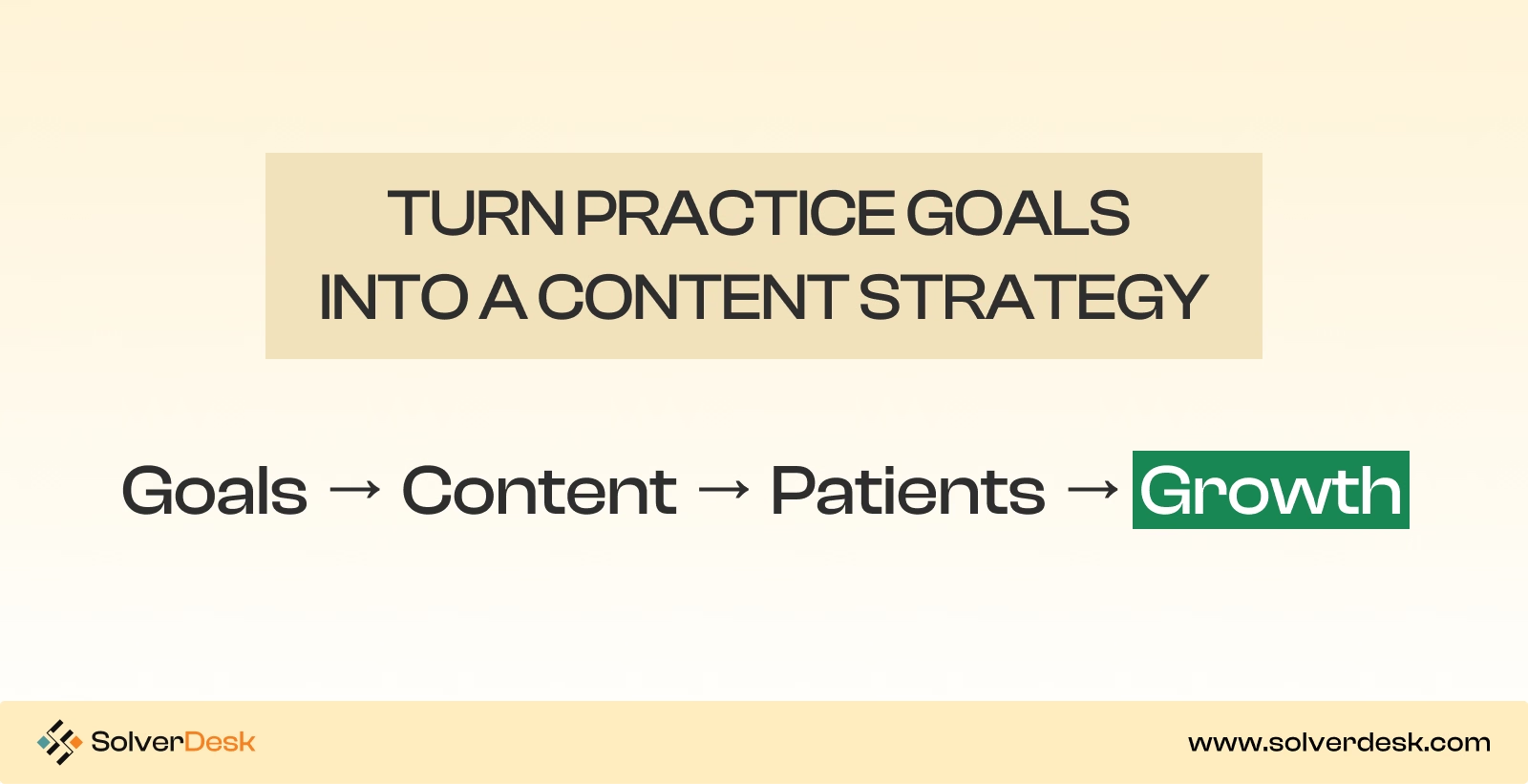
Every well-performing dental content marketing strategy starts with clear business objectives. So before you create content, first take time to identify which services drive the most growth for your practice. For this, don’t go with a vague mission statement.
We recommend checking your last 12 months of patient data instead. Which procedures actually pay?
Just rank them by margin. No matter whether the service is dental implants, Invisalign, or cosmetic dentistry. Remember, for every one of your business goals, the tone of the content marketing will be different.
For instance:
| Business Priority | Content Focus |
| High-margin cases | Implant, Invisalign, veneer guides |
| Fewer no-shows | Pre-appointment FAQ, prep content |
| New patient trust | Reviews, before/after, doctor-authority content |
| AI search visibility | Direct-answer FAQ pages, schema-marked content |
When you’re done, now map content to each stage of the patient journey. Here, you can review your Google Analytics 4, Google Search Console, or even booking data to identify opportunities.
Note:
Patients now ask ChatGPT and Google AI Overviews “best dentist for implants near me” before they ever open your site. So your goal must include AI citations. Better, you set specific measurable goals such as:
- Get 18 implant consultation bookings by March 31
- Get your practice mentioned in 3 AI-generated local search results
Step 2: Research Your Audience
An effective content marketing strategy in the dental industry must be built around patient questions, concerns, and treatment intent. Find out the ideal patients for your different services and analyze what they are actually searching for.
You can check Google Search Console, Google Business Profile Q&A, or even People Also Ask results to have a better overview of the audience. Some other sources include:
| Data Source | What It Reveals |
| Front-desk call notes | Real fears, cost questions, urgency triggers |
| GBP Q&A + reviews | Exact phrases patients use to search |
| Post-appointment surveys | What almost stopped them from booking |
| Website search bar (if enabled) | On-site intent, unanswered gaps |
Build personas around four things only:
- their core fear,
- preferred content format (video vs. text),
- where they search first, and
- what pushes them to finally book.
Then, group insights by search intent. It could be informational, comparative, and booking-focused. In this strategy, you can create content that aligns with the patient decision journey and attracts visitors who are more likely to schedule appointments.

Step 3: Audit the Contents
Before creating anything new, find out what’s already working and the points where they have failed. This is important because many practices publish new blogs regularly.
But outdated, underperforming content can continue to dilute topical authority. It greatly impacts search engine rankings.
So, check every blog, service page, and FAQ, and pull them into one spreadsheet. Now that you have everything, tag each by type, then check performance against three layers:
| Audit Layer | What to Check |
| SEO Audit | Rankings, traffic drops, indexation issues (Search Console) |
| Semantic Audit | Topic gaps, duplicate pages, cannibalized keywords |
| GEO Audit | Is this page structured to be cited by AI tools? |
Note:
Most dental sites fail the third layer completely. A page can rank #3 on Google and still be invisible in ChatGPT or AI Overviews if it’s vague or unstructured.
When doing all these, don’t miss reviewing your topic clusters, internal linking structure, and E-E-A-T signals to identify authority gaps.
For the damaged content, flag three buckets: pages to refresh, pages to merge, and pages to kill. Check every page or blog, as a five-year-old “dental implants” page with outdated pricing hurts you twice.
Step 4: Define Content Pillars and Buyer Journey Mapping
Random blog posts don’t build authority, so at this stage you have to focus on making effective content pillars that reflect the core services, expertise, and patient needs.
Organize content around major pillars such as:
- Dental Implants
- Invisalign
- Cosmetic Dentistry
- Emergency Dentistry
- Family Dentistry
- And Oral Health Education.
How to Choose Your Pillars
Run every topic through three filters before committing:
| Filter | Question to Ask |
| Patient demand | Are people actually searching this locally? |
| Practice relevance | Does it connect to a procedure you actually offer and profit from? |
| Competitive gap | Do nearby practices cover this shallowly or not at all? |
You can build one comprehensive pillar page per topic, which can be backed by 4–8 cluster posts that link back to it. This structure signals topical authority to Google and, increasingly, to AI search tools too.
Use the Big 5 Framework
Before writing a single cluster post, you can use the popular Big 5™ trademark framework.
It was created by Marcus Sheridan in his book “They Ask, You Answer.” Map it against what patients research before booking any procedure:
| Big 5 Topic | Patient Question | Content to Create |
| Cost | “How much do implants cost?” | Transparent pricing breakdowns, insurance guides |
| Problems | “What can go wrong with veneers?” | Honest risk/downside posts |
| Comparisons | “Implants vs. dentures?” | Side-by-side comparison guides |
| Reviews | “Is this dentist actually good?” | Case studies, video testimonials |
| Best in class | “Best implant dentist near me?” | Location-specific pillar pages |
Note:
If you are confused, better to contact our professional SEO team at SolverDesk. We build your full pillar-and-cluster architecture, mapped to the Big 5 framework, and localized for every service area you treat patients in.

Step 5: Dental Content Planning and Ideation
Now it’s time to turn your pillars into an actual publishing plan. This is where most practices get stuck. This is like great strategy on paper, but zero consistent output.
You can easily fix this issue through a content calendar built around real topics patients search for before choosing a provider.
Build the Calendar Around Three Inputs
| Source | What It Gives You |
| Content pillars (Step 4) | Which cluster topics to prioritize first |
| Buyer journey stage | Awareness, comparison, or decision content mix |
| Seasonal/local triggers | Back-to-school checkups, “new year new smile,” insurance renewal season |
Some of the common content topic examples include:
- Dental implant cost
- Invisalign vs braces
- root canal recovery
- tooth extraction aftercare
- emergency dental symptoms
- How long do dental implants last?
- Signs you need a root canal
- Dental crown vs filling
- What to expect during Invisalign treatment
- How much does teeth whitening cost?
- Are dental implants worth it?
- How to choose the right cosmetic dentist
- What causes tooth sensitivity?
For instance, don’t go with guesswork. The best suggestion would be to follow a proper strategy like:
- Front-desk questions logged that week
- Google’s “People Also Ask” for your target procedures
- Competitor gap analysis to check the topics they cover
- Past patient objections your team hears before every consult
In the era of AI Overviews, each of your ideas should be structured as a direct-answer topic first. AI engines and Google both favor content that answers the question in the first two sentences.
Step 6: Content Creation and Optimization (SEO + GEO)
When every campaign is done, this is the time to start creating the content. It should be optimized for both search engines and AI-driven search experiences. That means you have to write content for two audiences at once: search engines and AI answer engines.
Here is exactly what you need to do step by step:
Step 1: Study the SERP Before You Write
Check what’s already ranking for your target topic. Understand the format, depth, structure, and every “People Also Ask” question.
For instance, if the top results are 1,500-word guides with FAQs, a 400-word post won’t compete, no matter how well-written.
Step 2: Build the On-Page Checklist
For every piece of content, you have to go through an on-page checklist and optimize the content according to this:
| Element | Dental-Specific Application |
| Primary keyword | In title, intro, and H2s: “dental implants cost [city]” |
| Direct answer first | Answer the core question in the first 100 words, not paragraph five |
| Structured headings | Break by patient question, not by “Introduction / Benefits / Conclusion” |
| Alt text | Descriptive, not “image1.jpg” like “post-implant healing timeline diagram” |
| Internal links | Link to pillar page using natural anchor text |
Step 3: Apply E-E-A-T as Non-Negotiable in Healthcare
Google classifies dental content as YMYL. This refers to Your Money or Your Life. YMYL is Google’s label for topics that can impact a person’s:
- Health
- Safety
- Finances
- Well-being
Google uses human quality raters to evaluate search results. They don’t directly change rankings, but they help Google determine what high-quality content looks like.
For dental content, raters look for:
- Accurate information
- Qualified authors
- Trustworthy sources
- Real expertise
So you can understand that simply publishing keyword-optimized content is no longer enough. Moreover, your content should be optimized around E-E-A-T. E-E-A-T stands for:
- Experience
- Expertise
- Authoritativeness
- Trustworthiness
Some of the common tactics to build this authority would be:
| E-E-A-T Element | How to Show It (Dental-Specific) |
| Experience | Real case photos, before/afters, first-hand patient outcomes |
| Expertise | Every clinical post authored or reviewed by a licensed DDS/DMD, with credentials linked |
| Authoritativeness | Cite the ADA, peer-reviewed journals, or licensing boards |
| Trust | Visible “last updated” date, clear practice ownership, HTTPS, transparent contact info |

Step 7: Dental Content Distribution and Promotion
Even the best dental content may prove ineffective if patients never discover it. So after publishing, you must distribute content across channels where potential patients actively seek information. You can simply start with your Google Business Profile.
This is where you can share relevant blogs, treatment guides, and practice updates to strengthen local visibility.
Also, you can repurpose content into short-form videos, which you can utilize as social media posts. A short clip explaining “what to expect after a root canal” posted to Instagram, YouTube Shorts, or TikTok tends to get shared far more than a written post ever will.
Dental email lists regularly see open rates well above 30%-40%, which is far higher than most industries. Send new blog content straight to your patient list, especially if it is tied to seasonal triggers like back-to-school checkups or insurance renewal deadlines.
Consider these distribution routes too:
- Guest posts on local health or lifestyle sites, for backlinks and new audience reach
- Answering real patient questions on Reddit or Quora threads, genuinely, not as a sales pitch
- Treatment tips, before-and-after results, and patient success stories on social media
- You can promote high-value guides through Google Ads or social media advertising campaigns
- Or you can convert the blog articles into downloadable patient guides or checklists
Step 8: Content Measurement and Analysis
Content without measurement would be just guesswork beyond all your efforts. But here, your goal should not be to track more metrics. Instead, you have to track the ones that influence patient acquisition and practice growth.
Just start with monitoring the organic conversion rate. Check appointment requests, phone calls, consultation bookings, and treatment-specific leads generated from your content. This does not even end here.
There are some KPIs to track- the metrics that actually matter for a dental practice:
| Metric | Why It Matters |
| Organic traffic | Shows which topics pull in new visitors |
| Keyword rankings | Confirms whether your target phrases are gaining ground |
| Conversion rate | Tells you if visitors are booking, not just browsing |
| Time on page | Reveals whether content actually gets read or bounced from |
Set these up properly in Google Analytics 4 and Search Console, then check them monthly. Also review organic click-through rate, including engagement rate, scroll depth, and conversion paths. This is how you will understand how patients interact with your content
Step 9: Iterate, Refresh, and Compound
Content marketing isn’t a campaign you finish. It is the system that you have to keep updated based on your tracking results.
Regularly monitor pages with declining rankings and outdated treatment information. Then refresh them with updated clinical insights and current treatment costs. Also, check for:
- Two or three new sections covering questions patients actually ask now
- Broken or missing links to newer content on your site
- Images that look dated or generic
- An updated “last reviewed” date on the page
- Search behavior changes to identify refresh opportunities
Every optimization strengthens your existing authority and improves content longevity.
How Much Does Dental Content Marketing Cost in 2026?
Dental content marketing typically costs between $300 and $5,000+ per month in 2026. But it can vary based on whether you hire a freelancer, use AI-assisted tools, or work with a full-service agency handling strategy, writing, and distribution.
| Option | Monthly Cost |
| DIY (in-house writing + tools) | $50–$300 |
| Freelance content writer | $300–$1,500 |
| AI-powered content tools | $200–$800 |
| Dental content agency (full service) | $1,500–$5,000+ |
| Multi-location/DSO campaigns | $5,000–$10,000+ |
Note:
A dental practice that wants professional content marketing will often spend around $1,500 to $3,000 per month when they have to hire
- SEO specialists
- Content strategists
- Content writers
- Dental subject matter experts (SMEs)
- Editors and proofreaders
- Local SEO specialists
- Link-building specialists- all individually.
At SolverDesk, we provide strategy, content writing, and SEO/GEO optimization under one roof at an affordable cost. Instead of paying separately for a strategist, SEO specialist, content writer, and multiple software tools, you get a complete dental content marketing solution from a single team.
Addressing Common Dental Content Marketing Strategy Challenges
Every dental practice faces unique content marketing obstacles that can limit visibility and even patient engagement. Some of the common ones include:
- Keeping treatment information accurate as dental technologies and procedures
- It’s challenging when you have to explain complex dental procedures in patient-friendly language
- Building authority in highly competitive services such as Dental Implants or Invisalign
- Many dentists are skilled clinically but uncomfortable on camera, even though dental video marketing now drives the most engagement.
- Multi-location dental practices often struggle to maintain consistent messaging.
- Competition from large DSOs or Dental Support Organizations makes visibility more challenging.
- Rapid changes in dental technology and treatments can cause content to become outdated quickly.
- Balancing education with conversion goals is often difficult. Content must answer patient questions thoroughly while still guiding visitors toward consultations
Build a Well-Proofed Dental Content Marketing Strategy With SolverDesk
SolverDesk is a digital growth partner that helps dental practices build content strategies rooted in real patient questions.
From goal setting and content pillars to SEO, GEO, and distribution across every channel, we handle every step so your practice ranks, gets found, and gets booked.
Ready to stop creating content that goes nowhere? Request a free strategy consultation with SolverDesk today.
Frequently Asked Questions
How long does it take for dental content marketing to show results?
Most dental practices begin seeing improvements in organic visibility and patient engagement within three to six months. However, building topical authority and consistent appointment growth typically requires ongoing content efforts over a longer period.
Which content formats work best for dental marketing in 2026?
A combination of treatment pages, educational blogs, patient FAQs, short-form videos, before-and-after case explanations, and local content performs best. With different formats, you can easily capture patients across multiple stages of the research process.
Can small dental practices compete with larger dental groups through content marketing?
Absolutely. Independent practices often outperform larger competitors by creating highly localized, patient-focused content. Strong community relevance, local expertise, and treatment-specific authority can easily outperform larger advertising budgets in many markets.